Looking ahead to 2026, the biochar production market is expected to enter an even more robust growth phase. From a long-term development perspective, biochar is one of the important pathways for carbon sequestration. Its industrial development is deeply intertwined with global carbon neutrality goals, and market growth is highly certain in the next 5-10 years.
Driven by continuous technological innovation, the performance of biomass pyrolysis machine will be continuously optimized. This will further reduce the biochar production costs.
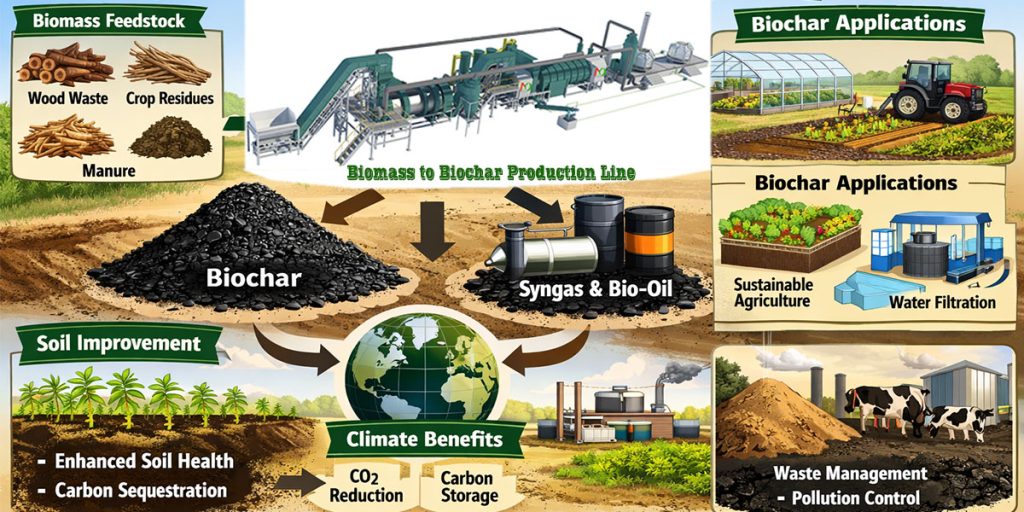
Currently, the biochar production market is in a phase of steady growth, with its development pace closely aligned with the expansion of the biochar end-use market. This growth is driven by a combination of factors. Including stricter environmental policies, soil improvement in the agricultural sector, and carbon sequestration strategies.
In 2025, the global biochar market size was US$859.04 million. The biochar production market size is projected to reach US$969.29 million in 2026, representing an annual growth rate of 12.8%. This forecast is based on the rapid expansion of the biochar market, with demand in areas such as carbon sequestration and industrial environmental protection growing significantly faster than in traditional agriculture.
The global policy framework is continuously improving, providing strong support for the biochar industry. The EU plans to fully implement a carbon removal certification mechanism in 2026, directly stimulating demand for biomass carbonization plant and integrated carbon capture equipment. The United States, through its regenerative agriculture support policies, is driving the use of biochar for crop and pasture improvement.
The agricultural sector remains the core demand scenario, with biochar improving soil water retention by nearly 30% and nutrient retention efficiency by over 25%. The agricultural sector accounts for nearly 55% of the biochar demand, directly driving the growth of the biochar production market.
At the same time, the carbon sequestration sector is experiencing explosive growth. In 2026, the annual carbon sequestration achieved through biochar is expected to exceed 10 million tons of CO2 equivalent. Companies like Microsoft have signed biochar carbon removal credit transactions of 100,000 tons, driving demand for continuous biochar production.
In the environmental protection sector, biochar-based filtration systems achieve over 60% efficiency in removing heavy metals and organic pollutants. 15% of industrial wastewater treatment projects are incorporating biochar into their standard processes, boosting demand for biochar in environmental applications.

An Australian general waste and tire recycling authoritative body turned to Environment Minister Sussan Ley in November last year with a request to prohibit whole bale tire…
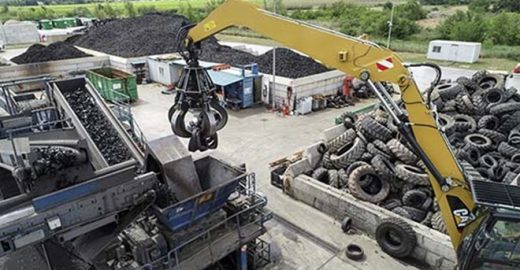
Aliapur – a French end-of-life tire management authority – recently announced a call for applications to participate in a tender to renew end-of-life tire collection and recycling contacts for 2021–2024..