Choosing biomass feedstock for biochar project is essentially choosing a conversion direction. Different biomass feedstocks determine the characteristics of biochar, which in turn determines its most suitable use and market value.
The core competitiveness of biochar projects lies not only in the biomass pyrolysis plant and processes, but more importantly, in the biomass feedstock. Your biochar project positioning will directly determine which raw materials are the optimal solution.
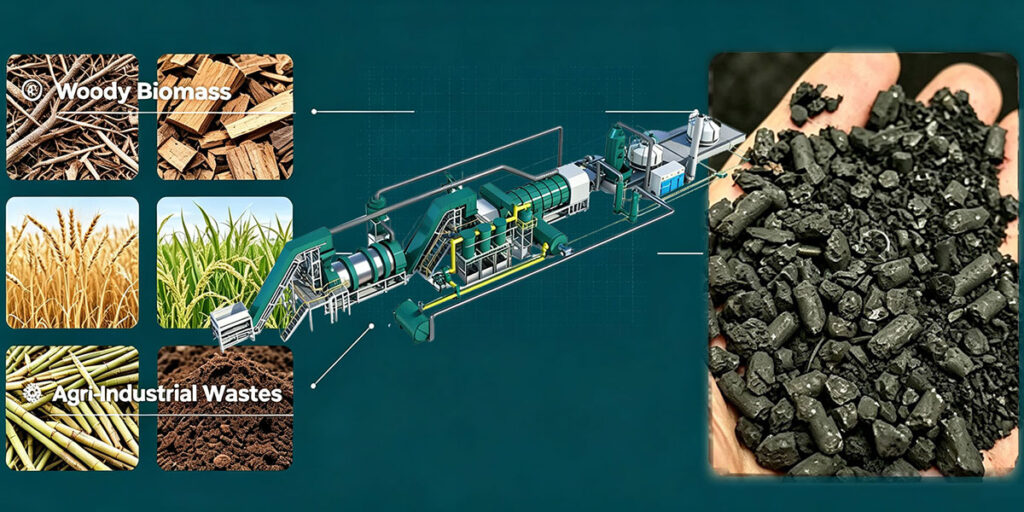
With the primary goal of carbon reduction and carbon trading, wood-based, bamboo, and nutshell-based raw materials are often the first choice. Biochar made from these materials has a high carbon content and a high degree of aromaticity. Biochar can remain stable in soil for hundreds of years, making it a high-quality carbon sink carrier.
Wood biomass includes wood chips, sawdust, and forestry residues. Wood-based raw materials are currently the highest quality and highest value-added biochar raw materials. Wood biochar is stable in quality, low in ash, and has a wide range of applications, giving it high market value. It is widely suitable for high-end soil improvement, water adsorption, carbon-based fertilizers, and activated carbon deep processing.
Bamboo waste includes bamboo chips and bamboo processing scraps. Bamboo charcoal is of good quality and the supply is relatively concentrated. Nutshell raw materials include coconut shells, palm kernel shells, walnut shells, and hazelnut shells. Nutshell biochar has high fixed carbon, good structure, and is suitable for high-value charcoal.
If the core customer is a farmer aiming for increased yield and income, agricultural waste materials offer a significant advantage. The high porosity of this type of biochar significantly improves the soil’s water and fertilizer retention capacity, directly impacting crop yield.
Rice husk biochar is high in silicon, wear-resistant, and corrosion-resistant, making it suitable for soil water and fertilizer retention. Straw biochar has a balanced nutrient content and abundant porosity, making it suitable for preparing common biochar-based fertilizers. Cotton stalks have a high degree of lignification, resulting in a higher charcoal production rate than ordinary herbaceous straw.
If you are looking for low-cost and waste resource utilization, agricultural and forestry waste, industrial biomass waste, livestock and poultry manure, and sludge are ideal choices. Utilizing abundant local waste resources can significantly reduce raw material procurement and transportation costs.
Chicken manure, cow manure, sheep manure, and other manure from large-scale livestock farming are raw materials for resource-based and environmentally friendly biochar projects. Animal manure biochar products are rich in organic nutrients such as nitrogen, phosphorus, and potassium, making them natural organic charcoal fertilizers. They significantly improve soil and enhance soil fertility, offering both environmentally friendly disposal and resource benefits.
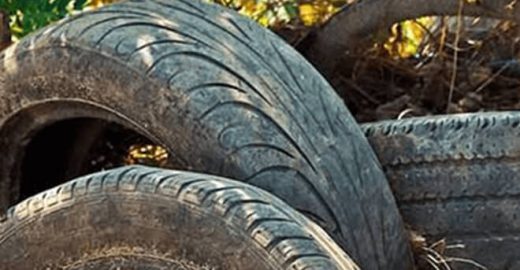
An Australian general waste and tire recycling authoritative body turned to Environment Minister Sussan Ley in November last year with a request to prohibit whole bale tire…
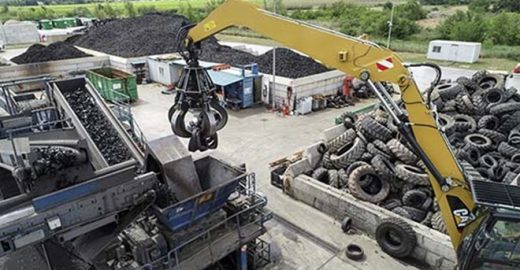
Aliapur – a French end-of-life tire management authority – recently announced a call for applications to participate in a tender to renew end-of-life tire collection and recycling contacts for 2021–2024..