Continuous pyrolysis plant is the foundation for ISCC certification of pyrolysis oil. It upgrades pyrolysis oil production from an unpredictable batch process to a quantifiable, traceable, and verifiable industrial production process. Quantifiable traceability is the core concept and practical cornerstone of ISCC certification.
ISCC stands for International Sustainable Development and Carbon Certification. Originating in Germany and launched in 2008, it is the most recognized third-party certification system globally for sustainable supply chains of biomass and recycled materials. Its core objectives are: independently verifying the sustainability, carbon reduction, traceability, deforestation prevention, and social responsibility of the entire raw material chain.
ISCC certification focuses not only on the composition of the final product but also emphasizes the verification of the "chain of custody" throughout the entire supply chain. The value of continuous pyrolysis plant lies in its technological ability to meet the fundamental requirements of this "chain of custody" for data accuracy and operational stability.
A key aspect of the ISCC system is using the quality balance method to calculate the attribution and content of recycled feedstock in the product. The operational logic is as follows: a known weight of recycled feedstock (pyrolysis oil) is mixed with fossil feedstock and fed into the processing unit (pyrolysis reactor). Then, based on the known conversion rate of the processing unit, the theoretical weight of the produced recycled product is calculated.
This calculation method is based on:
Accurate Feed Data: The weight of the recycled feedstock (pyrolysis oil) entering the system must be known and recordable.
Stable Operating Parameters: The conversion rate of the processing unit needs to be calculated based on stable and repeatable operating conditions.
The automated and standardized operation of continuous pyrolysis plant perfectly meets this requirement. Its feed rate is stable and controllable, and operating parameters are monitored in real time, providing a continuous and reliable data stream for ISCC quality balance calculations. In contrast, the quantity and quality of pyrolysis oil produced by batch pyrolysis plant have high uncertainty, making it difficult to provide a solid data foundation for rigorous calculations.
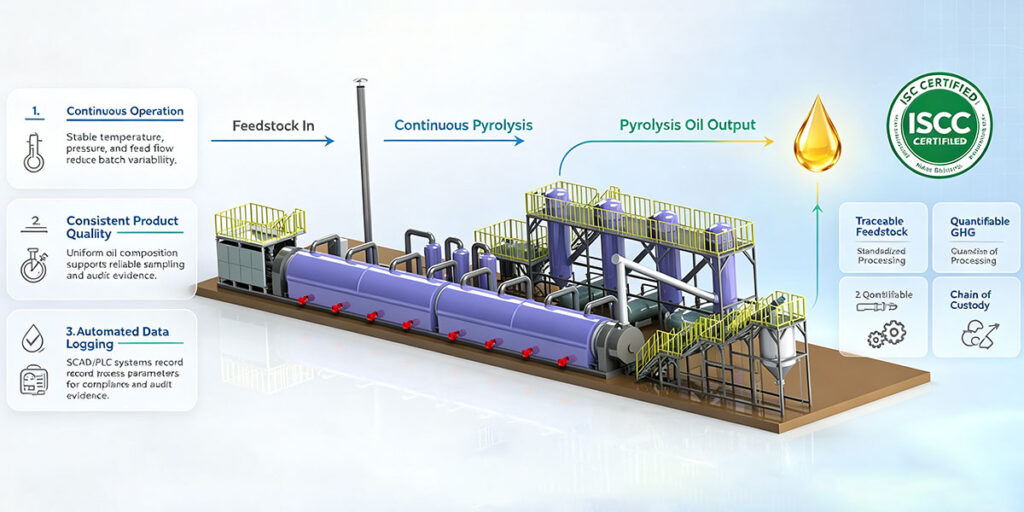
The effectiveness of ISCC certification depends on a company's ability to consistently meet its standards and requirements. For pyrolysis oil projects, this means the ability to consistently and reliably produce high-quality pyrolysis oil over a long period.
Continuous Operation Capability: Advanced continuous pyrolysis equipment, through optimized design such as anti-coking technology and intelligent control systems, can achieve uninterrupted operation. This long-term stable operation is the production guarantee for continuously producing large quantities of qualified pyrolysis oil, thus maintaining the effectiveness of ISCC certification.
Product Quality Management: Stable operation also means stable product quality. Stable quality pyrolysis oil is a prerequisite for downstream buyers to make long-term purchases and is also the foundation for passing ISCC certification audits.
Pyrolysis industry practices also confirm this connection. Many waste to pyrolysis oil projects that have obtained ISCC certification explicitly adopt continuous pyrolysis technology and consider it a technological guarantee for obtaining certification.
Continuous pyrolysis plants are the technological foundation for ISCC certification of pyrolysis oil. By enabling the production process to be quantifiable, traceable, and verifiable, it provides the industrial basis for the stringent ISCC certification system.
An Australian general waste and tire recycling authoritative body turned to Environment Minister Sussan Ley in November last year with a request to prohibit whole bale tire…
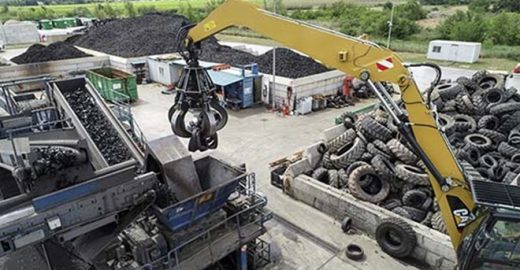
Aliapur – a French end-of-life tire management authority – recently announced a call for applications to participate in a tender to renew end-of-life tire collection and recycling contacts for 2021–2024..