Pyrolysis means that the solid waste is heated to high temperature in non-oxygen environment, then after the solidification, gasification and cracking of a variety of organic compounds under high temperature, finally achieved to get fuel oil, combustible gas and solid carbon material. Pyrolysis is an essential method for today’s waste-to-energy technology. With the increasing amount of municipal solid waste and a significant increase in solid waste disposal costs, the use of waste recycling technology such as waste to energy pyrolysis for resource utilization of solid waste has become a priority. Henan Mingjie Group provide one-stop service about waste to energy pyrolysis equipment by solving the comprehensive utilization of solid waste in one stop service. So, the development of global waste pyrolysis industry is also improving day by day.
The main difference between continuous and batch pyrolysis systems is their mode of operation. In batch systems, only one load can be processed at a time, and the system must cool before reloading. Continuous pyrolysis systems, however, can operate 24 hours a day without stopping. They allow fully continuous feeding and discharging. Feed material is constantly supplied to the reactor, while byproducts such as carbon black or biochar are continuously removed from the other side.
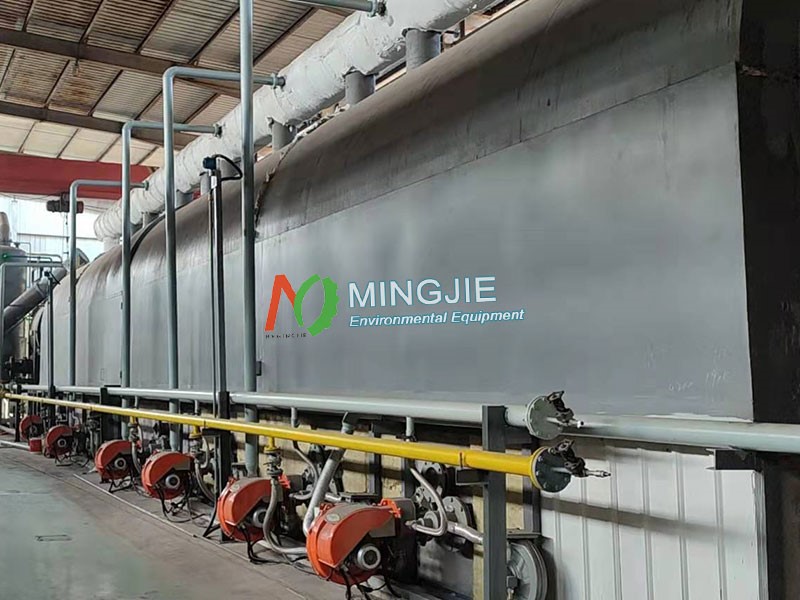
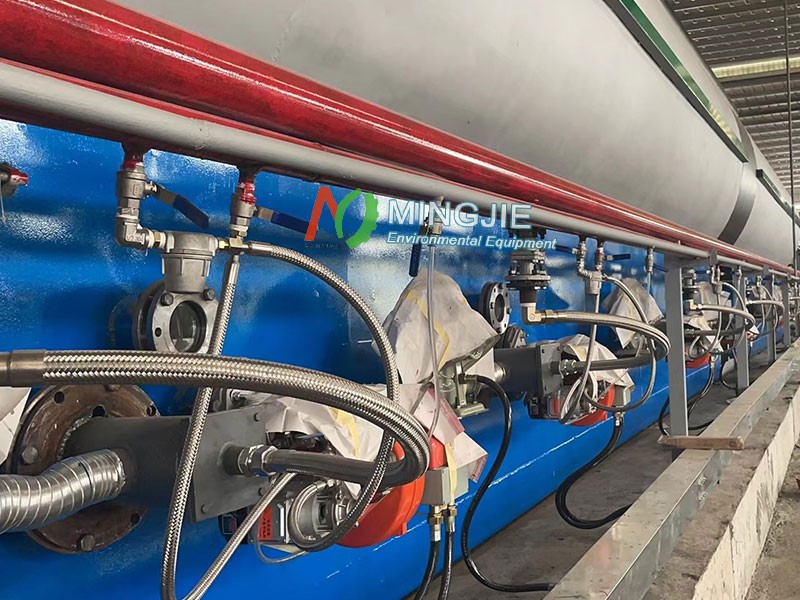
Main equipment of continuous pyrolysis plant 1. Feeding system 2. Reactor 3. Condensation system 4. Gas recycling system 5. The entire process, from feeding to discharging, takes place in a sealed environment, ensuring a clean working condition. The sealed design prevents environmental pollution and maintains high thermal efficiency of the furnace. A well-designed flue gas purification system ensures low emissions during operation. Meanwhile, full automation of various plant components allows online monitoring and adjustment of working parameters, such as temperature, pressure, and feeding speed, helping the system operate efficiently and safely.
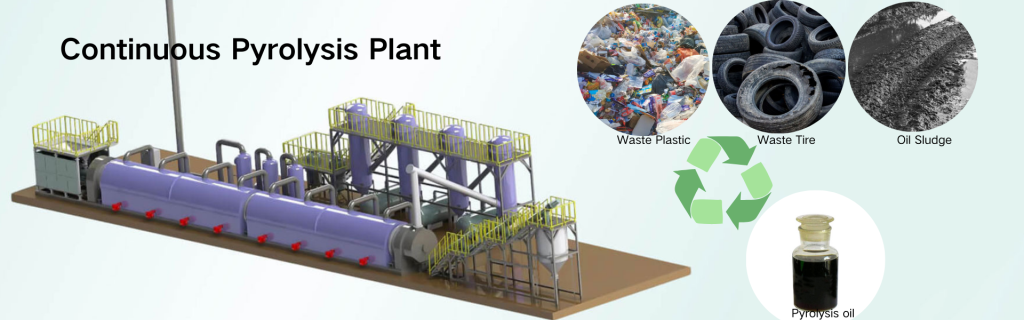
Continuous pyrolysis plants make waste less problematic for the environment by reducing landfill use. Pyrolysis significantly decreases the volume and weight of solid waste, lowering the need for landfills and reducing their negative environmental impact. By transforming municipal solid waste, plastics, rubber, sludge, and other organic materials into useful products, these plants strongly limit the reliance on landfills for waste disposal.
Emissions from continuous pyrolysis are significantly lower than those from incineration or open-air burning. In waste-to-energy pyrolysis, waste undergoes controlled decomposition in a low-oxygen environment. This prevents the large amounts of harmful gases and smoke produced during incineration, avoiding pollutants such as dioxins and sulfur oxides.
Additionally, pyrolysis produces less CO₂ than traditional incineration. By adopting this process, cities can reduce greenhouse gas emissions and move closer to achieving global climate targets through continuous pyrolysis in waste-to-energy applications.
Another major benefit lies in resource recovery through by-product generation. Mingjie pyrolysis plants can make solid waste become fuel oil, carbon black and syngas by a physical method. In terms of market value, the applications of products obtained from Mingjie pyrolysis plants are huge: our pyrolysis oil can be transferred to a refinery for desalting, heating, fractionation, catalytic cracking and reforming processes in order to obtain traditional diesel and gasoline. Meanwhile, we can also burn syngas to heat or generate electricity for generating power. Also, our carbon black or biochar can be sold to paint factories and rubber factories as well as spread on the fields. Biochar can be used as soil conditioner, carbon sequestration, fertilizer carrier. Such conversions not only close material loops but also promote circular economy principles.
Economic advantages are achieved by significantly reducing the operating costs of waste treatment, and by generating income from by-products and biomass derivatives. Actual operating costs of landfilling and incineration are very high because of transportation, landfill tip fees, air pollution control systems and the obligation to reserve large areas for possible future remediation. With the continuous pyrolysis technology the waste is therefore converted into a valuable biomass-based resource.
Pyrolysis waste to energy and chemical raw materials can achieve economic recovery and reduce waste treatment costs. The liquid fuels produced, often referred to as pyrolysis oil. can substitute conventional fossil fuels in industrial heating applications or power generation systems. When further processed through distillation technology, Mingjie pyrolysis oil distillation plant can convert pyrolysis oil into gasoline or diesel under high temperature decomposition. This adds another layer of profitability since refined fuels fetch higher market prices.
Revenue streams also include selling carbon black derived from tire or plastic feedstocks to rubber manufacturing industries or using biochar in agricultural markets where demand continues to grow due to its soil-enhancing properties. Biochar has a wide market demand and can bring additional income to enterprises.
Municipalities that adopt continuous pyrolysis technologies gain long-term financial benefits. They reduce landfill maintenance costs and generate revenue from recovered materials. The production of biochar is in line with the concept of circular economy and sustainable development. For private investors or industrial operators, continuous operation translates directly into higher return on investment since downtime between cycles is eliminated.
Recent technological progress has significantly improved how continuous pyrolysis plants operate. Automation plays a critical role: advanced sensors monitor every stage, from feeding rates to gas composition, ensuring consistent quality output with minimal human intervention. Equipped with a water-cooled automatic slag discharge system, no fly ash, high efficiency. This not only improves plant safety but also optimizes energy consumption.
Reactor design innovations have focused on achieving better heat distribution across feedstocks to maximize conversion efficiency. Advances in reactor design for better heat distribution and processing speed have enabled faster processing cycles without compromising product quality. Moreover, Special emission purification system ensures that even trace pollutants are captured before release.
Integration with other waste management technologies, such as sorting lines for MSW pre-treatment or distillation units for fuel refining, creates comprehensive resource recovery networks. Pyrolysis equipment has been widely used in MSW treatment, which not only provides solutions for MSW treatment, but also provides solutions for energy and value-added product recovery. By linking these systems together within smart city frameworks powered by digital control platforms, operators can track material flows from collection through conversion efficiently.
Despite its many advantages, implementing large-scale continuous pyrolysis facilities poses certain challenges. Technical issues often arise during setup due to variations in feedstock composition or moisture content that affect reaction stability. Feeding size shall be 5-8mm rubber granule, tyre shall be shredded and steel wire will be removed. Ensuring consistent particle size helps maintain uniform heating inside reactors, a key factor influencing yield rates.
Maintenance of continuous pyrolysis systems requires specialized training, as automated equipment includes complex mechanical components like condensers and scrubbers that operate continuously at high temperatures. Fully automatic biomass pyrolysis equipment is suitable for biomass materials larger than 20 mm and with moisture content between 15% and 65%.
Regulatory compliance is another important challenge, as environmental authorities enforce strict standards on emissions control. Unique flue gas treatment system designs effectively meet these requirements by filtering particulates before discharge.
To foster community acceptance, especially near urban installations, operators should emphasize transparency about safety measures and highlight tangible benefits such as job creation and reduced local pollution. Mingjie Group is committed to delivering innovative environmental solutions and promoting sustainable development.
Although both processes treat waste thermally, their mechanisms differ significantly. Incineration relies on complete combustion, producing ash and large volumes of CO₂. Pyrolysis, however, decomposes materials without oxygen, yielding reusable hydrocarbons. In a low-oxygen, high-temperature environment, pyrolysis equipment converts municipal solid waste into pyrolysis oil, syngas, and coke. Compared with incineration, pyrolysis produces fewer dioxins, NOx, and SO₂. Continuous pyrolysis therefore minimizes pollutants while recovering valuable resources, making it environmentally superior.
Safety remains paramount given operations occur at elevated temperatures under sealed conditions. The production is fully enclosed from feeding to slag discharge, and the operating environment is clean. Modern plants use multiple safeguards, including pressure relief valves, automatic shutdown protocols, flame arrestors, and real-time monitoring, to ensure stable operation even during emergencies. A specialized emission purification system further ensures that any released gases meet regulatory limits, protecting both workers’ health and surrounding communities.
Continuous pyrolysis offers exceptional flexibility when handling diverse inputs ranging from synthetic polymers through organic residues. Pyrolysis system can process many types of solid waste, including plastics, rubber, sludge, medical waste and biomass. Pyrolysis equipment is suitable for pyrolysis of various organic wastes: Pyrolysis of municipal solid waste; Pyrolysis of plastics; Pyrolysis of rubber; Pyrolysis of oil sludge; Pyrolysis of biomass. This adaptability allows municipalities industries & agricultural sectors alike adopt same core technology tailored toward specific local challenges ensuring maximum sustainability impact across multiple domains.
Through this combination, technological innovation economic viability & ecological responsibility, The modern continuous pyrolysis plant is not merely machinery but a cornerstone of infrastructure. It drives the global transition toward cleaner, circular economies built on resource regeneration instead of linear consumption models.
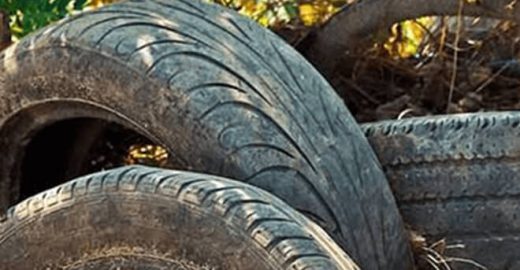
An Australian general waste and tire recycling authoritative body turned to Environment Minister Sussan Ley in November last year with a request to prohibit whole bale tire…
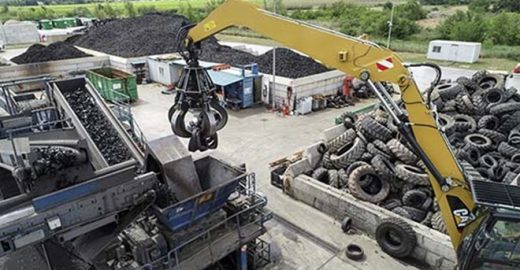
Aliapur – a French end-of-life tire management authority – recently announced a call for applications to participate in a tender to renew end-of-life tire collection and recycling contacts for 2021–2024..