Industrial pyrolysis equipment manufacturer Mingjie Group will participate in IFAT Brasil 2027, showcasing its mature continuous pyrolysis technology and solid waste treatment solutions. We offer solutions for the Brazilian market covering sewage sludge, agricultural and forestry waste, waste tires, and plastics, helping to establish a complete resource recovery value chain and drive the implementation of a circular economy.
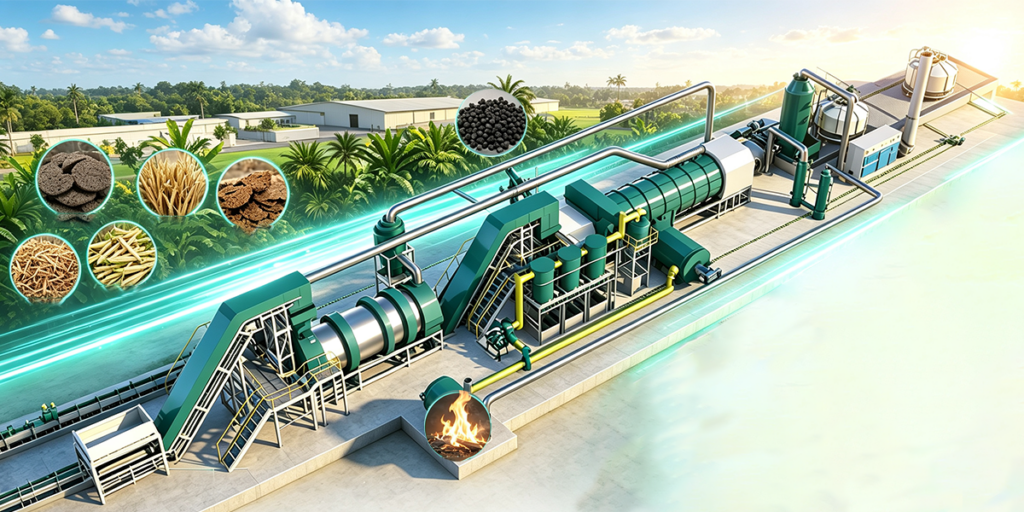
As the largest economy in Latin America and a global agricultural powerhouse, Brazil generates vast quantities of agricultural and forestry waste, municipal sewage sludge, scrap tires, and mixed plastic waste each year. Traditional disposal methods, such as landfilling and open-air burning, not only consume significant land and cause environmental issues like leachate and air pollution but also result in massive resource waste. With the ongoing implementation of Brazil’s National Solid Waste Policy, there is a rapidly growing demand for solid waste reduction, resource recovery, and low-carbon transformation.
Brazil boasts a massive agricultural sector, generating huge volumes of crop residues—such as sugarcane, soybeans, and coconuts—after each harvest. Simultaneously, municipal wastewater treatment plants continuously produce sewage sludge. Historically, most of this solid waste was burned in fields or sent to landfills, practices that not only released greenhouse gases but also posed risks of heavy metal and pollutant leakage.
In recent years, Brazil has tightened environmental regulations, gradually shutting down rudimentary landfills and raising mandatory targets for solid waste resource recovery. Carbon credit mechanisms and Extended Producer Responsibility (EPR) systems are also steadily advancing. The market urgently requires advanced technology and equipment solutions capable of processing organic solid waste while recovering energy and solid by-products.
Pyrolysis technology is one of the effective means of addressing this resource recovery challenge. Industrial pyrolysis is a thermochemical process involving the heating of suitable waste feedstocks under oxygen-deficient or oxygen-free conditions. Depending on the feedstock and process conditions, pyrolysis yields three main categories of products: pyrolysis oil, syngas, and carbon black or biochar. The specific product distribution is determined by the feedstock composition, the design of the pyrolysis equipment, and the pyrolysis process itself.
Pyrolysis oil is a recoverable liquid hydrocarbon product derived from suitable plastics, rubber, and other organic feedstocks. Carbon black is the primary product of the pyrolysis of waste tires or plastics, while biochar is the main product resulting from the pyrolysis and carbonization of sewage sludge and agricultural or forestry waste. Syngas is a combustible gas that can be used to heat the pyrolysis reactor.
We provide tailored industrial pyrolysis equipment solutions based on specific feedstocks and project plans.
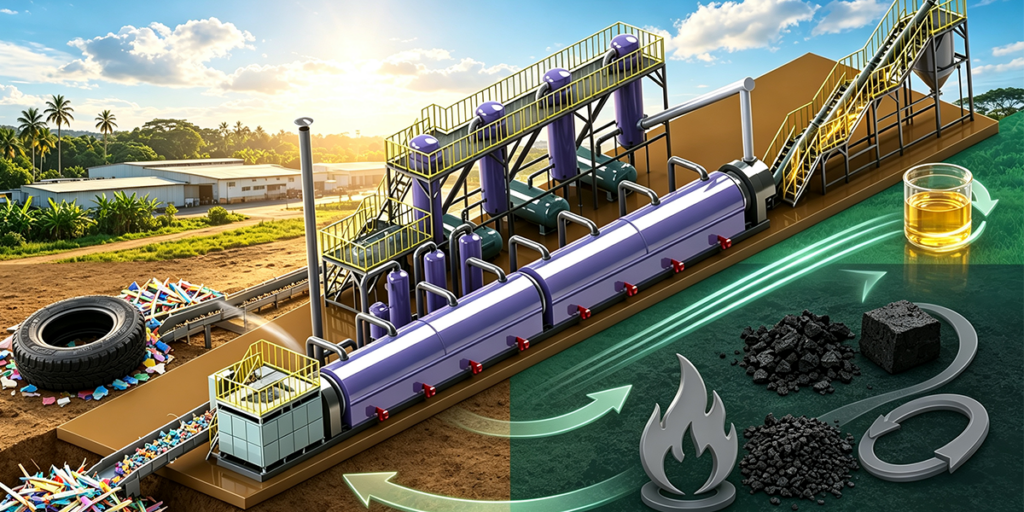
Industrial pyrolysis equipment for fuel oil production can convert waste tires, plastics, and oil sludge into pyrolysis oil, carbon black, and syngas. We offer a diverse range of equipment configurations, spanning from small-scale batch pyrolysis unit to semi-continuous and fully continuous pyrolysis system.
Industrial pyrolysis equipment for biochar production utilizes continuous pyrolysis technology and is suitable for processing sewage sludge, animal manure, and agricultural or forestry waste. The biochar production equipment convert sewage sludge and waste biomass into biochar and syngas. This process achieves significant solid waste volume reduction and the stable immobilization of pollutants, while producing biochar suitable for soil improvement. The biochar can also act as a carbon sink medium for participation in carbon credit projects. Syngas can be recycled to heat the reactor, achieving system energy self-sufficiency and reducing external energy consumption.
The biochar production equipment features a modular design, allowing for flexible model selection based on production scale. The complete system comprises a feedstock pre-treatment and feeding unit, a pyrolysis reactor, an oil-gas condensation system, a slag cooling and discharge system, a purification system, and an automated control and monitoring module. We offer various models of industrial pyrolysis equipment for biochar production, including the MJT-100, MJT-500, MJT-1000, MJT-2000, MJT-3000, and MJT-5000.
An Australian general waste and tire recycling authoritative body turned to Environment Minister Sussan Ley in November last year with a request to prohibit whole bale tire…
Aliapur – a French end-of-life tire management authority – recently announced a call for applications to participate in a tender to renew end-of-life tire collection and recycling contacts for 2021–2024..