Driven by ongoing urbanization, industrialization, and rising consumption levels, South Africa faces a need to manage diverse solid waste streams, including municipal solid waste, waste plastics, scrap tires, sludge, and agricultural and industrial solid waste. Concurrently, the country is actively promoting the reduction of landfill reliance, increasing resource recovery rates, and developing a circular economy—creating new opportunities for the application of advanced solid waste treatment technologies.
Notably, the draft National Waste Management Strategy 2026 proposes incorporating waste-to-energy into the national waste management hierarchy. It explicitly identifies technologies such as pyrolysis and gasification as acceptable pathways for energy recovery, while emphasizing the necessity of meeting environmental and public health safeguards.
Against this backdrop, industrial pyrolysis equipment presents a viable technological option for solid waste treatment projects in South Africa.
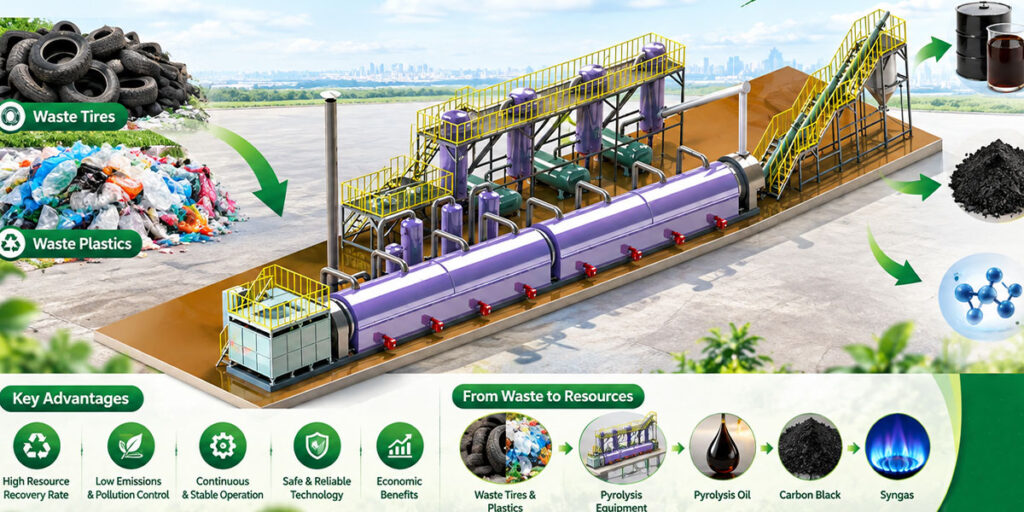
Mingjie Group offers industrial pyrolysis equipment for solid waste treatment. It features a modular design tailored to local operating conditions in South Africa. The pyrolysis system processes solid waste in a sealed, oxygen-free or low-oxygen environment, converting it into high-value products such as pyrolysis oil, syngas, and carbon black or biochar.
Variations in solid waste composition dictate the specific pyrolysis products and process designs. Different waste materials follow distinct thermal reaction pathways and yield different product outputs. Therefore, rather than relying on a single standardized unit, we provide customized, comprehensive pyrolysis equipment solutions based on the specific characteristics of the raw materials.
While all operate within the pyrolysis technology framework—utilizing high-temperature thermal cracking in oxygen-free or low-oxygen environments—Mingjie industrial pyrolysis equipment falls into two primary product lines:
Primary Target Product: Pyrolysis Oil
Suitable Feedstock: Waste tires, waste plastics, rubber, MSW and other high-organic-content materials.
The pyrolysis to oil plant maximizes liquid pyrolysis oil output by precisely controlling reaction temperature, residence time, and pressure. They are available in three operating modes: batch, semi-continuous, and fully continuous. The pyrolysis oil derived from tires and plastics can serve as industrial fuel or undergo further distillation and refining to produce diesel. Syngas can be recycled as a heat source for the pyrolysis equipment, thereby reducing operational energy consumption. The resulting carbon black can undergo further processing to become recovered carbon black.
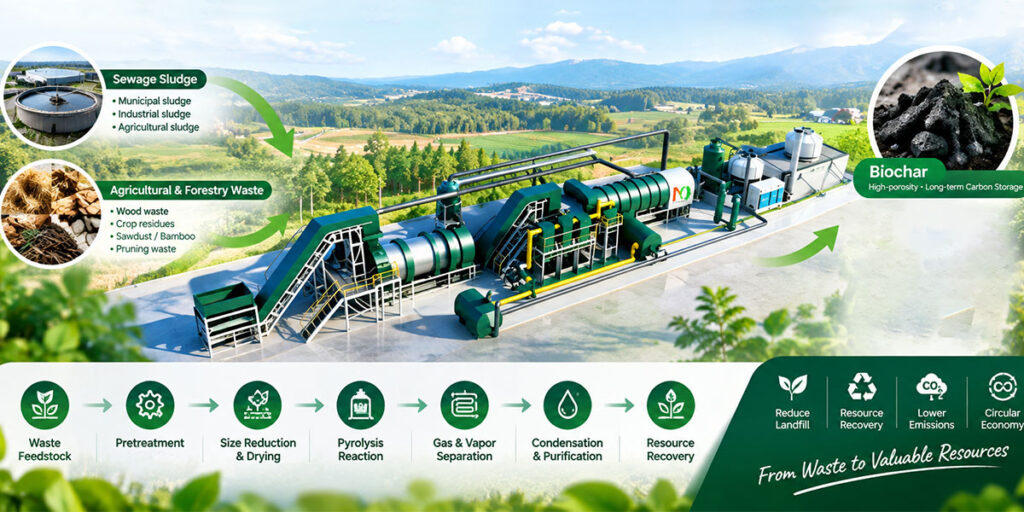
Primary Target Product: Biochar
Suitable Feedstock: Biomass solid waste such as crop stalks, wood chips, fruit shells, sludge, and livestock manure.
The biomass carbonization plant utilizes a continuous pyrolysis-carbonization process designed to preserve the solid carbon structure, resulting in the production of high-quality biochar. Biochar can be utilized for soil amendment, carbon sequestration, and carbon sink projects, while simultaneously recovering small amounts of combustible gas for the plant's own use. Biomass pyrolysis carbonization plant is suitable for projects involving agricultural waste treatment, carbon removal (CDR), and carbon credit development.
Both the pyrolysis to oil plant and biomass carbonization palnt are based on pyrolysis technology. They operate in a sealed, oxygen-free environment to inhibit the formation of pollutants such as dioxins and are equipped with comprehensive tail-gas purification systems to meet environmental compliance requirements.
Pyrolysis plant does more than just process solid waste, it enables resource recovery. Pyrolysis-based resource recovery technology is reshaping the business model of solid waste management. After undergoing pre-treatment, solid waste is fed into the pyrolysis system, where it is converted into marketable energy and carbon products, generating a stable cash flow. Additionally, the carbon emission reductions achieved by the project can be traded in carbon markets, creating an additional revenue stream.
An Australian general waste and tire recycling authoritative body turned to Environment Minister Sussan Ley in November last year with a request to prohibit whole bale tire…
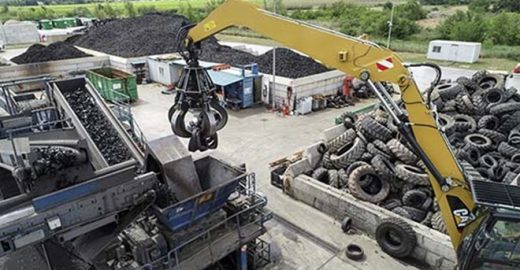
Aliapur – a French end-of-life tire management authority – recently announced a call for applications to participate in a tender to renew end-of-life tire collection and recycling contacts for 2021–2024..