Following years of global engineering evolution, sludge pyrolysis technology has advanced from a traditional, standalone pyrolysis process to an integrated, closed-loop system. The continuous sludge pyrolysis process also functions as a biochar production line: dewatering → drying → continuous feeding → pyrolysis and carbonization → gas utilization → biochar cooling and discharge.
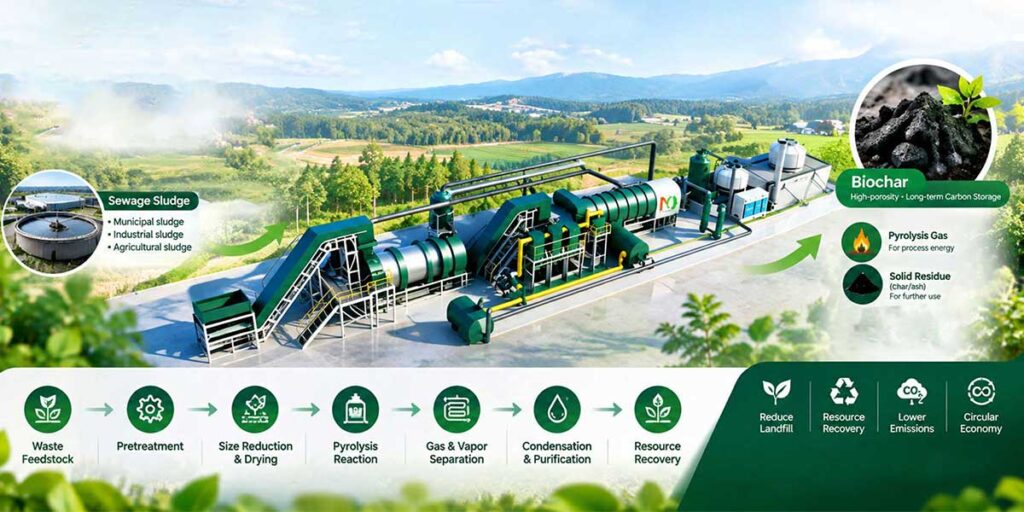
Raw sludge undergoes screening and conditioning to remove impurities and break down the sludge's colloidal structure. Excess sludge from wastewater treatment plants is first mechanically dewatered to reduce its moisture content. As dewatered sludge typically retains significant moisture, further thermal drying is required.
The dewatered sludge is fed into a sealed carbonization furnace, where it undergoes pyrolysis and carbonization at a constant temperature in an oxygen-deprived, slightly negative-pressure environment. Precise temperature control inhibits the formation of pollutants. Current mainstream equipment consists primarily of continuous biomass pyrolysis plant capable of stable, 24-hour operation, offering high processing capacity and uniform temperatures. The resulting biochar is of consistent quality, making it suitable for large-scale municipal sludge disposal projects.
Syngas generated during sludge pyrolysis is collected and combusted to release heat, the resulting high-temperature flue gas passes through a heat exchange system to recover waste heat. This heat is recycled to supply the sludge drying and furnace insulation processes, achieving system energy self-sufficiency and significantly reducing operational energy consumption. Small amounts of exhaust gas generated during the process are treated via a purification system. The resulting emissions surpass global environmental standards, eliminating concerns regarding secondary exhaust pollution.
The primary product of sludge pyrolysis and carbonization is biochar, alongside recovered syngas. Combustible syngas is prioritized for internal heating needs, with any surplus utilized for power generation. The solid biochar features a highly porous structure, strong adsorption capabilities, and stable heavy-metal immobilization, offering immense value for resource utilization.
Based on their physicochemical properties and local regulations, sewage sludge biochar can be further investigated for applications such as environmental remediation, adsorption materials, construction materials, asphalt materials, phosphorus resource carriers, soil-related uses, and long-term carbon storage.
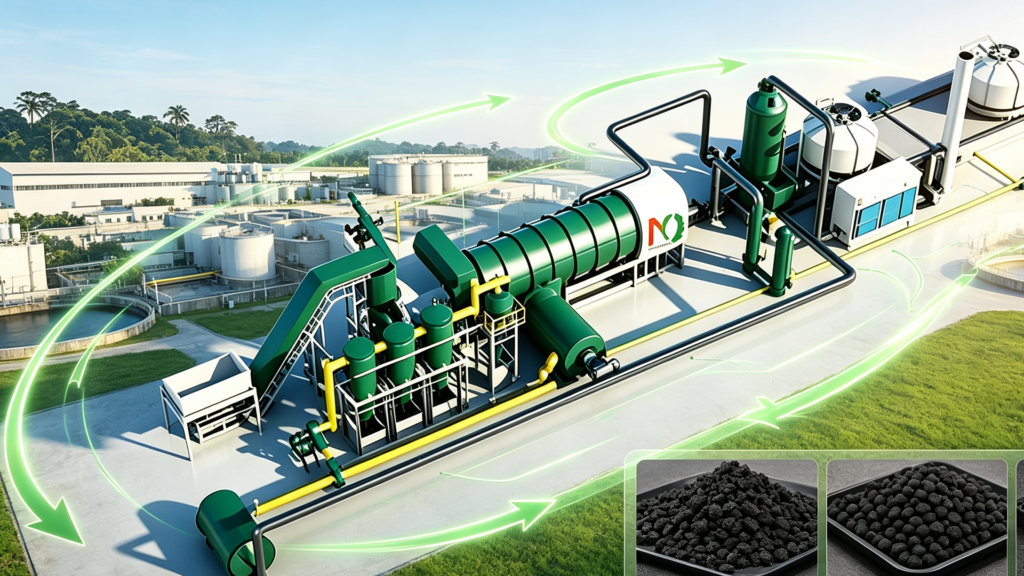
Compared to traditional sludge disposal processes, pyrolysis technology aligns with the four core objectives of solid waste treatment: volume reduction, harmlessness, stabilization, and resource recovery.
Extreme Volume Reduction, Conserving Land Resources
Following pyrolysis and carbonization, sludge volume shrinks by 70%–85%, and weight decreases by over 60%. This fundamentally resolves issues associated with landfilling, such as large land footprints and rapid consumption of storage capacity. It is particularly suitable for cities and industrial zones facing land scarcity, significantly lowering the land-use costs associated with solid waste disposal.
Deep Harmlessness, Eliminating Secondary Pollution
The oxygen-deficient, low-temperature environment inhibits the formation of highly toxic substances like dioxins and furans at the source, while high-temperature cracking thoroughly destroys harmful microorganisms such as pathogens and parasite eggs. Simultaneously, heavy metal ions within the sludge are firmly immobilized within the pore structure of the biochar during carbonization, resulting in leaching concentrations far below national standards. This prevents contamination of soil and groundwater via rainwater leaching, ensuring long-term, stable, and harmless sludge disposal.
High-Value Resource Recovery, Turning Waste into Treasure
Pyrolysis technology transcends the traditional role of sludge as merely a waste product requiring final disposal, establishing a "waste-energy-product" circular system. The resulting sludge biochar can be utilized in soil improvement, mine remediation, water body restoration, the production of adsorption materials and carbon-based fertilizers, or co-fired as fuel for power generation.
Low-Carbon and Energy-Efficient, Aligning with "Dual Carbon" Goals
The continuous sludge carbonization plant employs closed-loop recovery and utilization of waste heat, eliminating the need for significant external energy input and resulting in energy consumption far lower than that of sludge drying and incineration processes. Furthermore, the carbonization of organic matter creates a stable carbon sink, enabling long-term carbon sequestration and reducing greenhouse gas emissions. Compared to traditional processes, carbon emissions per unit of sludge treated are reduced by over 30%, aligning with global trends toward low-carbon, environmentally friendly development.
An Australian general waste and tire recycling authoritative body turned to Environment Minister Sussan Ley in November last year with a request to prohibit whole bale tire…
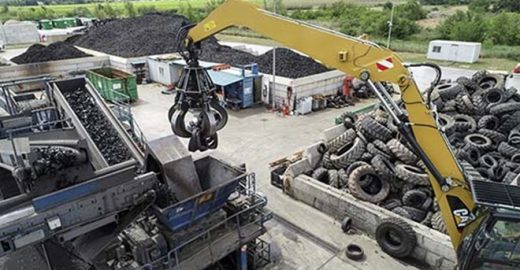
Aliapur – a French end-of-life tire management authority – recently announced a call for applications to participate in a tender to renew end-of-life tire collection and recycling contacts for 2021–2024..