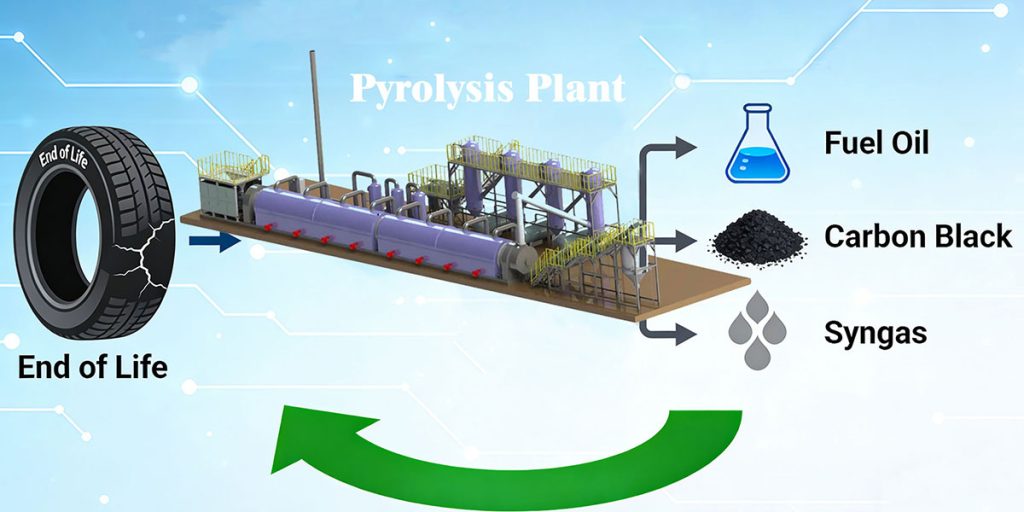
Waste tyre to oil pyrolysis plant has become an engineered solution that combines resource recycling and economic benefits. Facing the pressure of managing billions of waste tyres globally each year, pyrolysis technology represents a way to transform waste into valuable resources. Tyre pyrolysis plant not only recovers high-value pyrolysis products, enabling resource regeneration, but also addresses environmental pollution problems.
With the continuous strengthening of global environmental awareness, the market demand for waste tyre to oil pyrolysis plant will continue to grow. Many countries and regions have introduced strict environmental regulations to restrict the landfilling and incineration of waste tyres. This encourages the use of environmentally friendly and efficient pyrolysis technology for processing.
The European Union has formulated relevant waste management policies, requiring member states to increase the recycling rate of waste tyres. The proportion of waste tyre to oil pyrolysis is expected to increase gradually.
Some local governments provide financial subsidies to newly established waste tyre to oil pyrolysis plants, reducing the investment costs for businesses. They also offer preferential policies to companies engaged in waste tyre pyrolysis, improving their profitability.
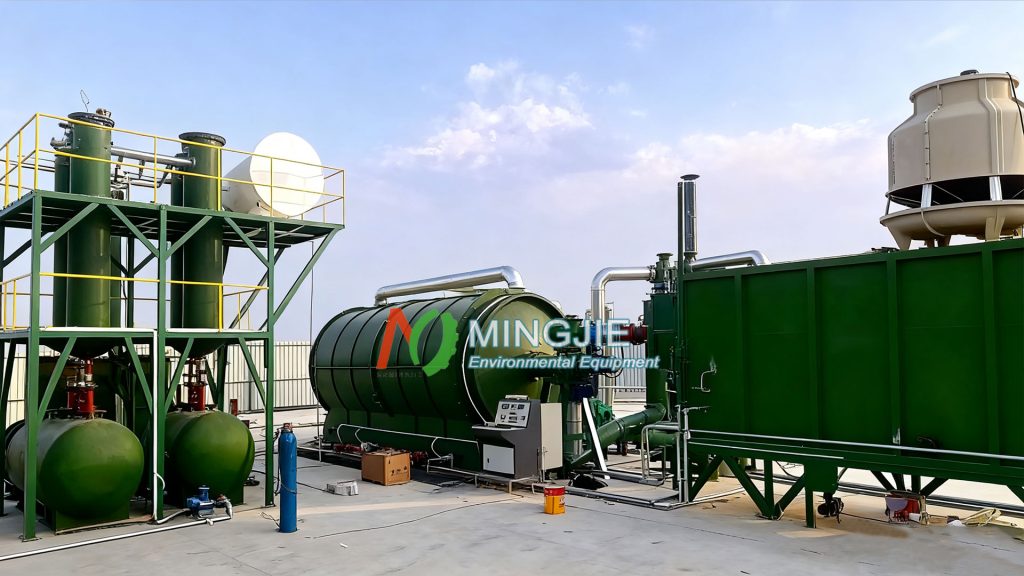
Bridgestone is building a new waste tyre pyrolysis plant in Seki City, Gifu Prefecture, Japan. The pyrolysis plant will process 7,500 tons of waste tires annually and is expected to be operational in 2027. This pilot project aims to transform waste tires into recyclable resources through precision pyrolysis technology.
By precisely controlling key parameters, it efficiently recovers decomposition oil and reclaimed carbon black from waste tires. Ultimately, these recovered resources will be recycled as raw materials for tires. It provides a groundbreaking technological solution for the low-carbon transformation of the tire industry.
On September 23, 2025, Enviro announced that the construction of its waste tyre pyrolysis plant in Uddevalla, Sweden, is progressing smoothly. The plant will be able to process 34,500 tons of waste tyres annually, equivalent to 40% of the total waste tires generated in Sweden each year. This waste tyre to oil pyrolysis plant offers a new solution to the global problem of black pollution.
The tyre pyrolysis plant converts waste tires into approximately 40% pyrolysis oil, 30% recovered carbon black, 20% steel wire, and 10% combustible gas. The products from the tire pyrolysis process can be used to support the sustainable raw material commitments of tire manufacturers. Environmental organizations estimate that processing 10,000 tons of waste tires can reduce carbon emissions by approximately 30,000 tons.
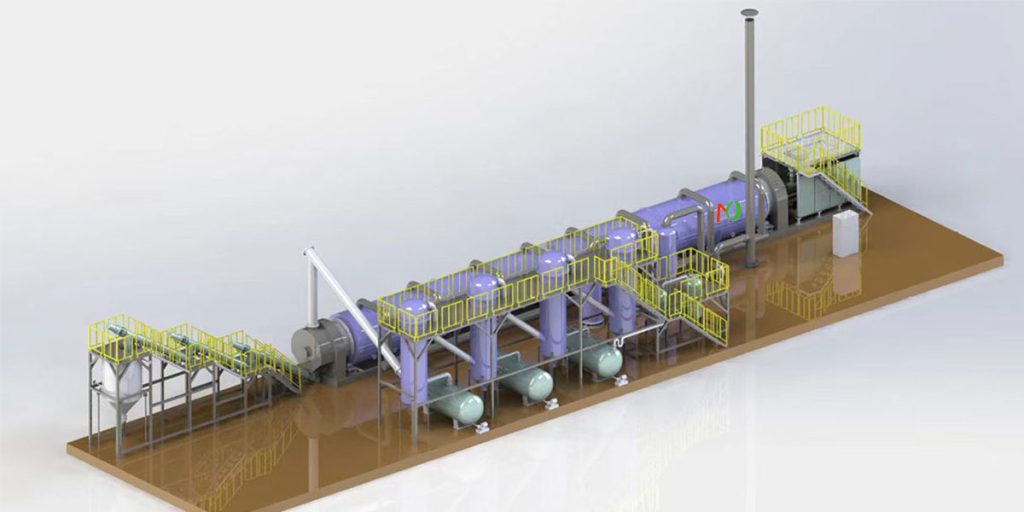
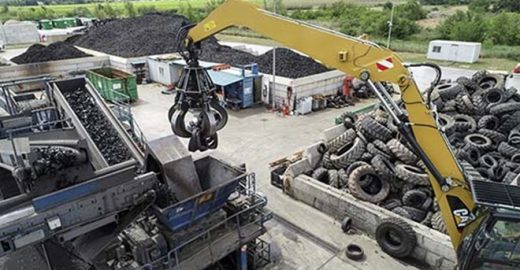
The waste tyre to oil pyrolysis project needs to be located near the supply chain for waste tire raw materials and product applications.
The layout includes a raw material storage area, pyrolysis workshop, carbon black deep processing workshop, raw material pretreatment workshop, carbon black finished product warehouse, gas supply area, power distribution room, oil tank area, desulfurization and denitrification area, circulating water system, emergency fire fighting area, fire fighting tank area, loading area, sewage treatment area, gas storage device area, air combustion area, emission area, and office area.
The pretreatment workshop should be located near the raw material storage area and should be large enough to meet the required production capacity.
The processing scale is determined based on the amount of waste tires available at the pre-selected site, and further refined based on funding and market demand.
Raw Material Supply: We maintain a reserve of raw materials sufficient for more than two months of operation.
Equipment Configuration: The pretreatment equipment has high capacity and low energy consumption. The waste tyre continuous pyrolysis plant has a high oil yield and excellent oil quality. The carbon black deep processing equipment and testing instruments are comprehensive, and each stage features a high degree of safety and production automation control. Outdoor utilities are fully equipped.
Operating Cost Control: Hire professionals to control operating costs.
An Australian general waste and tire recycling authoritative body turned to Environment Minister Sussan Ley in November last year with a request to prohibit whole bale tire…
Aliapur – a French end-of-life tire management authority – recently announced a call for applications to participate in a tender to renew end-of-life tire collection and recycling contacts for 2021–2024..