Bamboo charcoal manufacturing is undergoing an industrial revolution, from earthen kilns to intelligent equipment. Traditional bamboo charcoal production relies on earthen kilns and several days of manual labor. It is not only inefficient but also causes serious environmental pollution. Today, the emergence of biomass carbonization equipment is propelling bamboo biochar production into a clean, efficient, and continuous era of large-scale industrial production.
The bamboo biochar production by pyrolysis is a highly efficient and sustainable solid waste recycling technology. It perfectly solves the environmental problems caused by the traditional extensive treatment of bamboo waste, realizing a transformation from waste accumulation to high-value resource utilization. Bamboo biochar possesses a unique porous structure and stable physicochemical properties. It has broad application prospects in ecological restoration, agricultural improvement, and carbon neutrality.
How to make biochar from bamboo? Mingjie Group provides skid-mounted small biomass pyrolysis equipment and fully automatic large scale carbonization equipment for bamboo biochar production. Both utilize continuous pyrolysis equipment, enabling 24-hour continuous production of bamboo biochar.

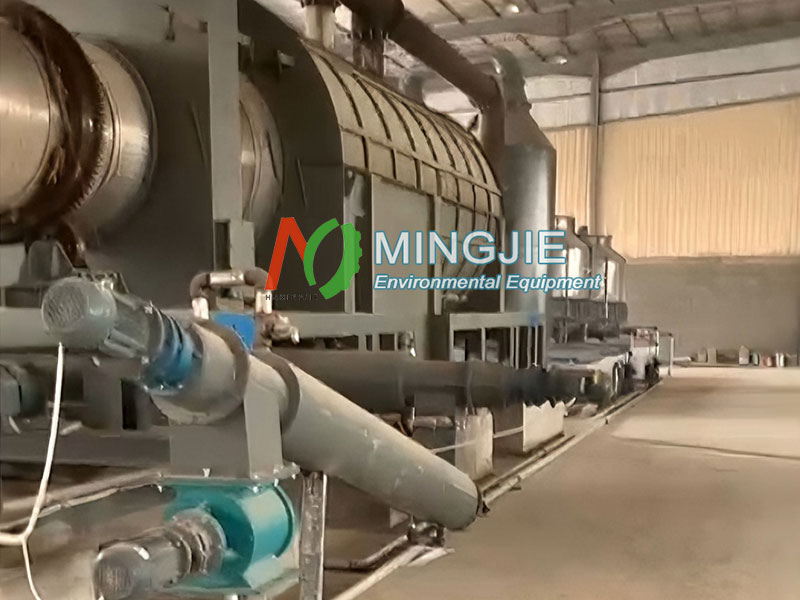
Unlike open-air burning, the entire bamboo pyrolysis process takes place in a closed, negative-pressure environment. It eliminates the need for open flames, fundamentally avoiding the generation of harmful pollutants such as dioxins. Bamboo waste undergoes thermal decomposition and carbonization under medium-high temperature and low-oxygen conditions. Organic components such as cellulose, hemicellulose, and lignin gradually decompose and carbonize, while inorganic components remain stably retained.
The final solid product is high-purity bamboo biochar, with volatile components converted into combustible syngas and bio-oil. Through energy recovery and tail gas purification via a continuous pyrolysis system, the entire process achieves the reduction, harmless treatment, and resource utilization of bamboo waste.
Superior Product Quality: Thanks to the high lignin content and dense structure of bamboo, biochar produced from pyrolytic bamboo waste has a richer microporous and mesoporous structure and a larger specific surface area than straw and wood biochar. It exhibits superior performance in heavy metal passivation, organic pollutant adsorption, and soil carbon sequestration.
High Resource Utilization and High Economic Value: The biochar production process achieves multi-product synergistic recovery. In addition to high-value bamboo biochar, syngas and bio-oil are also recovered and utilized, forming a diversified value-added system. The volume of bamboo waste is reduced by more than 80% after carbonization, completely solving the land occupation and environmental pollution problems caused by waste dumping.
Energy-Saving and Environmentally Friendly Production Method: The closed-loop energy cycle system achieves self-sufficiency in the energy required for production, greatly reducing operating costs. The entire process adopts a closed negative pressure operation, inhibiting the generation of harmful pollutants from the source. Zero discharge of wastewater and solid waste is achieved during the production process, meeting the requirements of green and clean production.
Intelligent and Low-Maintenance Operation: The biomass carbonization equipment is equipped with a PLC intelligent control system. It can automatically monitor and adjust temperature, pressure and feed rate to achieve fully automated operation and fault warning.
An Australian general waste and tire recycling authoritative body turned to Environment Minister Sussan Ley in November last year with a request to prohibit whole bale tire…
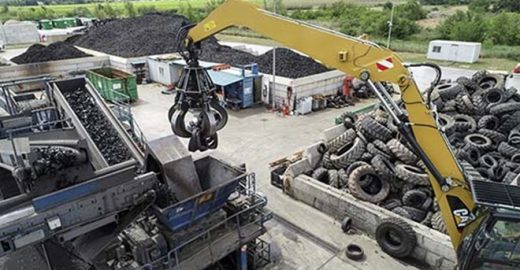
Aliapur – a French end-of-life tire management authority – recently announced a call for applications to participate in a tender to renew end-of-life tire collection and recycling contacts for 2021–2024..