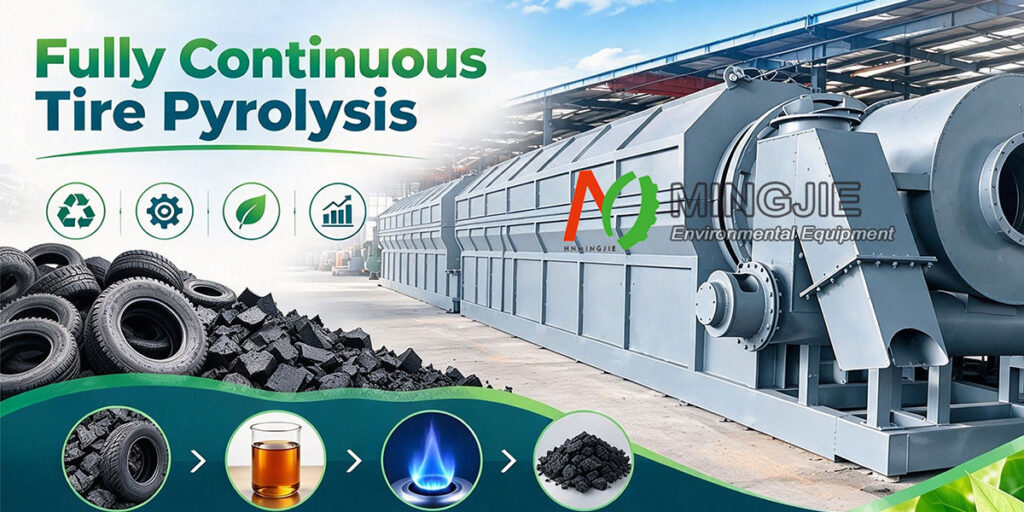
In the field of resource recovery from waste tires, fully continuous tire pyrolysis technology has increasingly become a key driver for industrial upgrading. Compared to traditional batch-processing methods, fully continuous pyrolysis offers superior stability in production flow and enhances the quality of the output. Furthermore, through the deep processing of pyrolysis oil and recovered carbon black, the resource value of waste tires can be maximized.
The core process of fully continuous tire pyrolysis include feedstock intake, the pyrolysis reaction, oil-gas separation, and condensation/recovery.
In this process, waste tires are no longer viewed merely as solid waste requiring disposal; rather, they serve as a source for pyrolysis oil, recovered carbon black, steel wire, and combustible gases. Among these, pyrolysis oil and recovered carbon black are the two primary products that determine the economic viability and resource utilization efficiency of a fully continuous tire pyrolysis project.
Pyrolysis oil is a key liquid product recovered during the fully continuous pyrolysis plant. Typically dark brown or brownish-black in color, it possesses a high calorific value. Through further refining and fractionation, pyrolysis oil can serve as an alternative to conventional fuel oils and can also be utilized to produce chemical feedstocks.
For fully continuous pyrolysis projects, the value of pyrolysis oil lies not only in its production but also in the ability to achieve higher yields and improved product stability. Continuous, stable operations enable these projects to produce high-quality pyrolysis oil, thereby enhancing its market adaptability.
Recovered carbon black (rCB) is the primary solid product derived from the waste tires pyrolysis. It possesses excellent reinforcing properties and significant potential for industrial application, making it highly versatile for use in rubber products, plastic fillers, black masterbatches, and construction materials.
For fully continuous tire pyrolysis projects, the value-enhancement pathway for recovered carbon black focuses on three key areas:
The advantages of a fully continuous tire pyrolysis project lie not only in its processing capacity, but also in the consistent quality of its output. Continuous operation minimizes fluctuations in process conditions, ensuring greater control over the quality of the pyrolysis oil and recovered carbon black. This, in turn, facilitates the downstream deep processing and commercial sale of tire pyrolysis products.
An Australian general waste and tire recycling authoritative body turned to Environment Minister Sussan Ley in November last year with a request to prohibit whole bale tire…
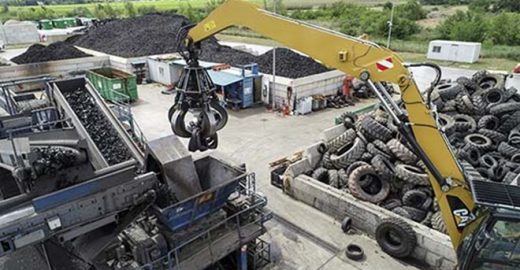
Aliapur – a French end-of-life tire management authority – recently announced a call for applications to participate in a tender to renew end-of-life tire collection and recycling contacts for 2021–2024..