The circular economy for waste tires represents a systemic solution. Through a series of tiered strategies—complemented by appropriate policy and infrastructure support—a closed-loop system is established.
Among the various pathways for end-of-life tire (ELT) recovery, a comprehensive value fully continuous waste tire pyrolysis chain stands out as the most robust and scalable business model for achieving a circular economy for waste tires.
ELTs → pre-treatment → continuous pyrolysis → tire pyrolysis oil (TPO) + recovered carbon black (rCB) + steel wire → applications in the energy, chemical, rubber, and steel industries
This circular economy for waste tires model meets regulatory requirements for the compliant disposal of waste. It also establishes a systematic industrial framework that transforms waste rubber into traceable raw materials.
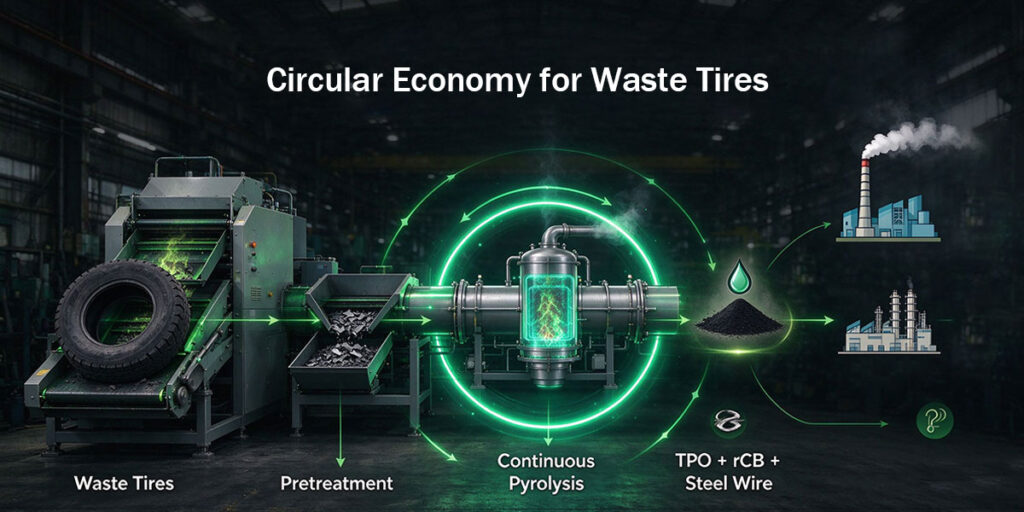
ELTs must undergo pre-treatment processes, including shredding, granulating, magnetic separation, and impurity removal. Maintaining a consistent feedstock particle size, minimizing impurity content, and ensuring uniform feeding are critical to the continuous pyrolysis process. This initial pre-treatment stage guarantees a stable supply.
The core of this value chain is the fully continuous pyrolysis plant. Within a sealed reactor maintained in an inert environment, rubber particles are subjected to thermal decomposition at controlled temperatures, yielding tire pyrolysis oil (TPO) and carbon black. The pyrolysis syngas is captured and reused as an internal heat source for the reactor, significantly reducing external energy consumption and lowering carbon emissions.
Every component of the end-of-life tire is recovered, thereby avoiding the loss of material value that occurs when tires are used simply as tire-derived fuel (TDF).
Tyre Pyrolysis Oil (TPO): With its high calorific value, TPO can be used directly as an industrial fuel for kilns, boilers, and heating facilities. It can also be sent to an oil refinery for further processing, where it is converted into chemical feedstocks, fuel blending components, and petrochemical intermediates. This bridges the circular value chain for end-of-life tires (ELT) with the energy and chemical industries.
Recovered Carbon Black (rCB): Following post-processing steps such as milling, pelletizing, and surface modification, high-quality recovered carbon black can serve as a partial substitute for virgin carbon black. It is widely used in applications including tire compounds, rubber products, plastic masterbatches, coatings, and inks.
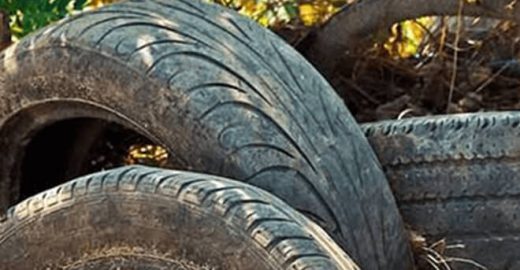
An Australian general waste and tire recycling authoritative body turned to Environment Minister Sussan Ley in November last year with a request to prohibit whole bale tire…
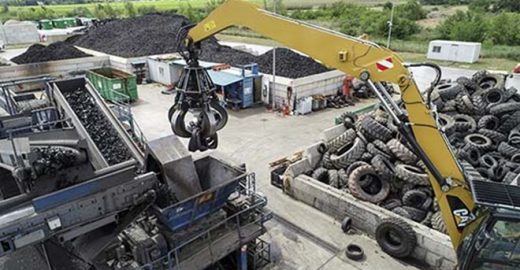
Aliapur – a French end-of-life tire management authority – recently announced a call for applications to participate in a tender to renew end-of-life tire collection and recycling contacts for 2021–2024..